Carrots
Filter by:
Carrots Suppliers


Gardener's Supply is proud to be employee-owned. We are gardeners ourselves and have earned our customers' trust by providing high-quality products, expert information, and friendly, personalized service.
We understand the products we sell because we use them in our own gardens. Regular product training sessions and a gardening certification program for our staff help us provide the best service and support in the business.

We offer only the best seeds we can find. Our seed packets are the largest quantity for the smallest price around! Our grass seed is the best in the area, and our fertilizer will keep your lawn looking its best!

Our seeds are grown here, on our Certified Organic land (TCO Cert is our certification body). The seeds are not certified, however, as I have yet to make time for the paperwork required. But rest assured, they are Non-GMO and heirloom wherever possible, always open-pollinated, so you can save them too.

Domesticated carrots are a very familiar and common root vegetable. Daucus carota var. sativus, was bred from the wild carrot (Daucus carota var. carota), quite different in appearance (and taste). Wild carrot roots are usually white or yellow and branched. The leaves are edible, and the roots have been used for thousands of years medicinally. Carrots as they are known more commonly today are cultivars descended from carrots from Iran and Persia.
Domesticated carrots are a very familiar and common root vegetable. Daucus carota var. sativus, was bred from the wild carrot (Daucus carota var. carota), quite different in appearance (and taste). Wild carrot roots are usually white or yellow and branched. The leaves are edible, and the roots have been used for thousands of years medicinally. Carrots as they are known more commonly today are cultivars descended from carrots from Iran and Persia. These gradually spread west, first in northern Africa, then in Spain, and then made their way to northern Europe. By about the 1500s, orange carrots bred from yellow cultivars became very widespread, and this is the carrot we all know.
Carrots can be prepared in a variety of ways. They can be chopped or grated for salads, sauteed, boiled, steamed, and of course, roasted. True baby carrots are sweeter and more tender than full-grown carrots, but be aware that “baby carrots” as sold in stores are most often just full-grown carrots cut smaller as “baby-cut carrots” for packaging. Carrot greens can also be eaten, carrot-top pesto is popular, and they can be served cooked as part of any dark greens recipe.
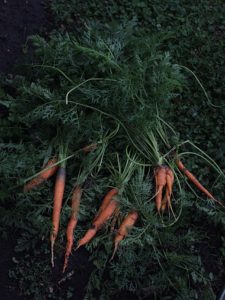 There are four basic types of carrots: Chantenay, Nantes, Danvers, and Imperator. Chantenay carrots are short and thick, with rounded tops and ends. and grow well in heavy soils that are not the best for other carrots. They are up to 5 inches long, and about 2 inches thick. Nantes carrots are a bit longer and more narrow, and very sweet. Danvers carrots are usually 6 to 7 inches long, and an inch thick or more. Imperator carrots are the largest of the main four types, usually 7 or 8 inches long, sometimes even longer. They are 1 to 2 inches thick. All of these come in different varieties, both open-pollinated and hybrids. They are usually orange, but some are tinted purple, yellow, or even white.
Carrots are very high in vitamin A and beta-carotene. They are also a good source of vitamin C, and vitamin K. The plant is low in sugar and high in fiber. It’s an extremely healthy vegetable, a really good source of nutrition. It’s commonly used to aid digestion and can reduce cholesterol.
- Carrot (Daucus carota var. sativus)
- Annual (biennial)
- Full sun
- Soil should be neutral to slightly acidic (6.0 to 7.0 ph)
- Soil should be light, loamy, and slightly sandy. Soil that is a bit harder is okay for
the smaller varieties.
- Start seeds directly in the garden, in midsummer for a fall harvest. Spring planting
should be done three or four weeks before the last frost for summer harvest.
1/4” deep
1″ apart
Thin to 3-4” apart once sprouts begin to show
- Containers:
Deep pots are best, to allow full root growth for larger carrots. Large pots allow
several carrots to be grown at once
- Rows should be up to 18-24″ apart
- Water regularly, keeping the soil moist.
- Climate Zones 3-10
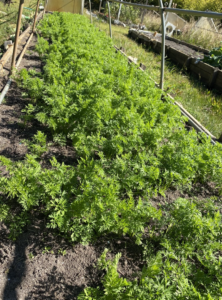
Carrots do better in cooler weather. These can be planted in midsummer for a fall harvest, or in spring for a summer harvest. It’s a good idea to harvest carrots planted in the spring a bit earlier, while still slightly immature. The heat of the summer tends to make the carrots tougher, and not as sweet. Carrots need warmer weather for germination, and grow better as they mature in cooler weather. In warmer climates (zones 8-10), planting in the fall for a winter harvest is generally the best approach. Ideally, temperatures close to 70°F or so is best for planting, and temperatures near 40°F for the harvest work the best. Somewhat warmer or cooler temps will be fine. Soil should be kept moist throughout the growing season to help keep the carrots from drying out and branching. For garden planting, it’s best to plant your seeds directly in the garden, about an inch apart, then thin the plants to about 3-4 inches apart. Transplanting root vegetables is difficult, young plants are quite delicate.
 Container gardening is another great option for carrots! This helps with the temperature range since the pots can be moved indoors if it gets too hot (or too cold). For larger carrots, very large pots are required. For an 8″ carrot, the soil should be 12” deep at least inside the pot. It’s easier to use a shorter rounded carrot for container planting, such as the Chantenay, since it can be grown in a somewhat smaller container. Pots should drain well, and the carrots should be watered often. The soil does need to be kept moist. In a wide and deep container, many carrots can be planted, since they can be seeded only a few inches apart.
Pests and diseases can be a problem, but careful planning can greatly help with this. Diseases such as leaf blight, root rot, and crown rot, are seen somewhat often. Ground-level watering, rather than overhead watering can help prevent all of these diseases, as can ensuring good drainage and using seeds that are known to be disease-free. Crop rotation is key, as well, it’s best to avoid planting vegetables in the same spot every year. A three to four-year rotation is best.
Carrot rust flies are one of the best-known pests, and they are hard to get rid of. These eat through the very bottom of the carrots and leave a rust-colored tunnel in the root. Carrot weevils are another pest that burrows into the carrot, though they eat into the top part of the root. Row covers and crop rotation are good prevention for both of these pests. Carrot weevils can be treated, with some success, with a neem oil spray. Cucumber beetles are another carrot pest. These beetles attack the greens. Another preventative strategy is companion plants!
There are a variety of good companion plants for carrots. For pest prevention, garlic and onions, as well as rosemary, leeks, chives, and even sage all mask the odor of carrots, which helps to deter rust flies and other pests. Another useful companion plant is tomatoes, which can help shade the carrots in the summer sun, help with pests, and may improve the flavor of the carrots. Tomatoes and chives also may have other beneficial effects, like improved taste, and are Marigolds are a good all-around companion in the garden, deterring many pests with their strong scent.
Carrots should be harvested either a bit early, if you are looking for the more tender baby carrots, or later when they are at full size. Carrots are fully mature at about 75 days, for many varieties, so often baby carrots are harvested about 60 days after planting. It’s important to know the specific time frame for the variety you are planting. Danvers and imperator carrots take a bit longer to mature than the nantes or chantenay carrots. If planting from seed, check the package, because there is considerable variation among the different cultivars and hybrids. Once the crowns are bulging out of the ground, it is at or near time to harvest. It’s good to harvest the day after a rain, or after watering, and also to loosen the soil a bit first, to make sure the carrots come up whole.
If you are planting heirloom or open-pollinated seeds, you can harvest the seeds once they go to flower. Carrots are a biennial for purposes of seed production, so for seed harvest, it’s best to plant in midsummer, and leave a few in-ground for the seed harvest. Allow them to over-winter, they will flower and go to seed the next year. For garden planting, only plant one variety of carrots, to avoid unintentional hybrid plants.